Saturday, February 4, 2012

WADI - Wonderful Livelihood Security for Tribals


The “Wadi” project, named after a system for land-based production in local parlance, is doing wonders for rural livelihoods in northeastern distirct of Raigarh in chhattsigarh state. The programme has especially promoted agro-horticulture and agro-forestry, thereby enhancing the socio-economic status of the resource-poor families, and has so far helped about 200 households in improving their livelihoods and crossing the poverty line. This project is sponsored by the National Bank for Agriculture and Rural Development (NABARD), and running in 4 villages of the tribal-dominated Gharghoda block . Raigarh based non-government organization JanMitram is implementing the project sanctioned by NABARD under its Tribal Development Fund with the objective of bringing about a transformation in the rural landscape within the next couple of years. The initial results have depicted an increased access to nutritive food, better resource maintenance and reduction in migration to cities.


Talking of Development 
The project's main beneficiaries are Below Poverty Line (BPL) families whose annual income is below Rs.25,000 per anuum. Their livelihood portfolio comprises agriculture, animal husbandry and labour, which is only of subsistence type due to small land holding, degraded pasture and forests, low-yielding animals and large extent of wasteland farms. Except during the monsoon, people in the region do not get any work opportunities and their livelihood shifts to uncertainties, forcing them to depend mainly on daily wages in distant labour hubs. JanMitram’s President Dr. Mukesh Goswami says the project's main strategy is to initiate plantation of permanent nature, including fruit, fodder, timber and fuel trees, with an integrated resource management. Other activities have addressed important aspects of horticulture, forestry and allied systems, which can yield high productivity.

The project is bringing a steady improvement in family resource management as well as in the productivity of land and water units for the poor families, says Dr. Goswami. The project is also designed to address vulnerability of target families, including those in the BPL and near poverty line, against fluctuating climatic conditions. it shall strengthened the rural livelihood scenario by successfully connecting missing links of resource management in agriculture, forestry, animal husbandry,  and fruits.

Mahesh Pahadsingh, The district Development Manager of NABARD in raigarh, says that major component of the strategy is poverty reduction through improved access of resource-poor families, which also take part in formulation, implementation and monitoring. A cluster approach has been adopted for implementation so as to have better replication, while long-lasting effects of sustainability of the promoted practices will be attained through family-based livelihood planning for effective use of existing resources.
A Wadi Site, showing fruit plantation with inter cropping 

Mr Pahadsingh told that activities undertaken as part of the project include plantation, construction of piped water courses and storage tanks, vermicomposting, nutritional gardening, field training camps, gender sensitization, chlorination of water sources, installation of solar lighting systems and awareness camps on water-borne diseases and control.A survey conducted at the project's initiation included the indicators of agricultural production and economic value, existing trees and their productivity, cattle population, farm practices and fodder production. On the basis on these inputs, the results of livelihood interventions shall be estimated. The project is all set to reduce input costs in agriculture and animal husbandry systems on the one hand and enhance production on the other in the years to come. Support in the shape of Wadi would strengthen the economy of primary production in wastelands.

Dr. Goswami says -JanMitram had laid emphasis on providing an important role to women in decision-making and involved them in a big way in economic activities and non-traditional roles. Besides, the village communities have been organized under Village planning committee,  so as to sustain efforts for production enhancement and equitable benefits. He tell that cost of the project was initially estimated at Rs.80 Lakh, while the community's contribution during the implementation would bring it down to Rs.73 Lakh. The economic changes would especially benefit the poor community, whose major land holdings are the sloping wastelands and eroded stream banks.
Onsite Training of Farmers 
Additionally, the village development programme (VDP) is also running parallel in these villages for  the families  who did not covered under WADI. This prgramme is designed to build capacity of farmers and availing assistance through convergence of different government schemes. This has brought an environment of cooperation among various departments i.e. Agriculture, Horticulture and animal husbandry. all such departments are now reaching these villages to make demonstration of techniques. Over 200 acres of land has now brought under SRI ( Seed intensification in rice), over 50 acre land under vegetable cultivation. 3 New farmers clubs have been formed.     

While tribal communities in the region earlier had a forest resource based livelihood, large-scale deforestation forced them to shift to farming activities on a sloping land and caused degradation. Continued and damaging run-off resulted in the loss of agricultural land along the stream course and led to an adverse effect on the ground water conditions in the district.

According to Dr. Goswami, NABARD had extended financial help to JanMitram for enhancing skills, improving resources and building new institutions in the field of land-based production mainly through resource development and management. “Recycling of nutrients is an added advantage of the project,” he says.

On its conclusion, the project is expected to make the target tribal households “drought-proof” with better nutritional resources and increase per hectare unit yield of different crops. With the livelihood available locally, production efficiency is set to improve and linkages for sustainable development strengthened.

---------------------------------------------------
janmitram@gmail.com
---------------------------------------------------


In Chhattisgarh Assembly, RTI Applicants Face New Hurdles


THE CHHATTISGARH Assembly will now consider an applicant’s intent before giving information under RTI. It might even refuse the application if it is convinced it has been made with mala fide intent. This clearly goes against the RTI Act, which says that an applicant requesting information shall not be required to give any reason. But can intent be ascertained without asking the reason?

The Assembly enforced this rule last month by issuing a notification. It has also hiked the fee for an RTI application concerning the Assembly from Rs 10 to Rs 500. And the copy of documents provided will also cost more, setting citizens back by Rs 15 per page instead of Rs 2 charged elsewhere in the country.

“Earlier, there were no (specific) rules for the Legislative Assembly. We adopted this model from Uttar Pradesh,” says Assembly Secretary Devendra Verma.
Expensive info  at the Chhattisgarh Assembly 
Chhattisgarh Speaker Dharam Lal Kaushik defends the notification saying the information regarding the questions raised by MLAs is still provided at a cost of Rs 1 per copy and the higher fee would apply only to the information sought about the Assembly.

RTI activists aren’t amused by the Assembly’s decision. “The underprivileged will have to sacrifice a lot of money to file an RTI application. It goes against the spirit of the law,” says Shekhar Singh, a member of the National Campaign for People’s Right to Information (NCPRI), the NGO that was instrumental in bringing the RTI Act.

Veteran RTI activist Subhash Chandra Agrawal adds that this model would encourage other states to follow suit. “This is despite the Department of Personnel & Training requesting, in its circulars, states and competent authorities to maintain a uniform fee of Rs 10,” he says.

Central Information Commissioner Shailesh Gandhi couldn’t agree more. “Bad practices get easily copied and this is disappointing,” he says. “The intent clause is disrespectful of the law. The RTI Act talks of a reasonable fee and Rs 500 is not reasonable. These (legislative) bodies just don’t want to give information.” Gandhi has shot off letters to the CM, Leader of the Opposition and the Speaker asking them to maintain the fee at Rs 10 per application and Rs 2 for additional copies.

This is not the first time that such a regressive step has been initiated by the Chhattisgarh government. In 2009, it limited the word count to just 150 and number of subjects to one for each RTI application. The restriction was also adopted by the Madhya Pradesh Assembly in 2010. “Restricting the subject to one is illegal under the RTI Act as it clearly provides for even partial transfer of application to other authorities if all the information is not available with one department,” says NCPRI’S Nikhil Dey.

Similarly, Prateek Pandey, an RTI activist of the Chhattisgarh Citizen Initiative, says there is lack of clarity. “Once I asked the former State Information Commissioner (SIC) to define ‘subject’ and he just smiled. If the SIC can’t answer that, how will a Public Information Officer? Everyone interprets it in his own way,” he says.

The SIC recently ruled against the “Speaker’s privilege” to deny information in the case of an applicant seeking audit reports of the accounts of the House and the applications received by it. Many MLAs have also been in the line of fire due to information obtained under RTI last year, which revealed that they had been receiving gifts such as microwave ovens, washing machines, etc., in violation of rules.

The way ahead is either to accept the decision meekly or wait for someone to fight it out in court saying that the notification is unreasonable and unlawful. Shekhar Singh says that this confrontation can be avoided. He gives the example of Manipur, where the government had introduced a similar rule and when the activists wrote to them, the state authorities reduced the application fee.
-----------------------------------------------------------------------------------------------------------
By Prakhar Jain - prakhar@tehelka.com
-----------------------------------------------------------------------------------------------------------

Mitanins-Changing Face of Community Health

A global trend favouring large-scale interventions by Community Health Workers (CHWs) has paid huge and unexpected dividends in Chhattisgarh, where CHWs called mitanins have not only substantially improved infant mortality rates but are also meeting the goal of holistic development
Creating Bond of Friendship- Mitanins with Davapeti

They've improved child survival rates in the state, furthered local women's participation in the community, and helped ensure people's right to food. What's more, Chhattisgarh's 60,000-strong volunteer Community Health Workers (CHWs), or mitanins ('friends' in the local language), have done all this in a relatively short period of time, armed with just a bag of basic drugs, a little training, loads of enthusiasm, and empathy.

A government-civil society partnership started in 2000, the mitanin programme is widely credited with bringing the rural Infant Mortality Rate (IMR) in Chhattisgarh down from 85 deaths per 1,000 live births in 2002 (the second highest in the country) to 65 in 2005, much the same as the national rural IMR of 64.

Rewind to the beginning of the decade. In the context of high illiteracy and poverty, and with a third of the population being tribal, the 3,818 health sub-centres (staffed by one auxiliary nurse each) were unable to provide outreach services to the 18 million rural people dispersed over 54,000 habitations. Infants in the impoverished tribal- and scheduled caste-dominated region remained malnourished despite a network of anganwadis; primary health centres 'functioned' without doctors.
Fighting against malnutrition- Weighting and followup of malnourished children 

There was an urgent need for someone to act as a link between the service and the beneficiaries, someone who could counsel the villagers and encourage them to seek improvements in service as a matter of right. Who best to do this but women from within the community itself?

In consultation with various civil society representatives, a government-funded network of 54,000 women community volunteers was formed through an MoU between the state government and civil society. The mitanin programme is run by an autonomous state health resource centre parallel to the health department.

The mitanin programme envisaged a synergy of health services at the community, outreach and facility levels as essential for its success. Mitanins would carry out family-level outreach activities such as essential care of newborns, nutritional counselling, and case management of illnesses that are common in childhood.

The role of these volunteers evolved over time into a set of activities that focused on child survival and essential care of newborns, and into another set of rights-based activities that enabled access to basic public services as fundamental entitlements to be secured through women's empowerment and community action.

A team of 3,000 motivated women were engaged as middle-level supervisors and trainers to address the issues of human resources and poor support from health personnel.

The Koriya region of Chhattisgarh may have been mineral-rich but its Gond and Kerwa tribal communities were dirt poor. Despite this, none of the government programmes, including the Integrated Child Development Services (ICDS) had reached them. Childhood infections were rampant, and infant mortality high.

Finally in 2003, the state government decided to appoint a mitanin in every village. The change thereafter is visible on the faces of children in Rokda village, where Rambai is a mitanin. Since being appointed, Rambai has treated hundreds of infections, tracked and counselled pregnant women on nutrition, and ensured that all infants were breastfed and immunised. "Earlier, women were starved for the first six days and the babies were fed cow or goat's milk with a cloth. Many children died as there was a lot of malnutrition. Now I tell women to breastfeed the children for six months, and then start on supplementary food. I tell the women to feed them five to six times, whatever they themselves eat. I also tell women to eat green leafy vegetables, depending on what is available. If there aren't any vegetables, I tell them grow them so that they don't have to buy them," she says.

Other mitanins in Koriya began sending complaints to the district collector about the poor state of anganwadis and primary health centres. When no action was taken, they approached the Supreme Court commissioners on the right to food. They wrote to the state government and action was immediate. About 10,000 complaints have so far been received against the public health centres alone, according to programme officials.

Now, even as the mitanins go about their work, the Dekh Rekh Samiti, a monitoring committee, visits anganwadis and schools every week to oversee their functioning. "We check whether teachers come or not, whether food is being served in the anganwadi and whether the rations are reaching pregnant women," says Gangabai, a member. In fact, they have already written to the administration that a new centre needs to be built near the school.

"Along with providing healthcare, the mitanins have focused on food programmes like the ICDS and midday meals scheme, and helped mobilise communities around them," says Samir Gar of the Adivasi Adhikar Samiti, Chhattisgarh. "Now there is a full house at the anganwadi, as children flock there for food, and Rambai helps the anganwadi worker with the cooking."

Malnutrition in Koriya has since dipped from 73% in 1999 to 66% in 2006.
Mitanin gathered  in a get together  programme 

Today, there are mitanins in 60,092 of 72,000 hamlets in Chhattisgarh. "At least 45,000 of them are active in organising the community to access public health facilities and 6,000 were able to bring about some change in their community, to get doors opened for the villagers," says state coordinator Raman, a former activist at the Kerala Shastra Sahitya Parishad.

"Mitanins don't get salaries. The honour they get in society makes them come forward," says Raman. "In fact, 5,000 of them stood for panchayat elections and got elected," he adds. This is the biggest band of activists after China's barefoot doctors, proud officials claim.

"Much of the improvement in child survival rates in Chhattisgarh undoubtedly relates to better health-seeking behaviour and childcare practices. The initiation of breastfeeding during the first two hours after birth increased from 24% of live births to 71% of live births, and the use of oral rehydration salts in the management of diarrhoea in children younger than three years increased by 12% in the two weeks before the survey," says a review of the programme published in a recent issue of the British medical journal The Lancet. "Overall, the state has seen the number of underweight children fall from 61% to 52%. In addition to this, immunisation has increased from 22% to 49% in the 1-2 age-group."

By :  Lisa Batiwalla, for InfoChange News and Features
-----------------------------------------------------------------------------------------------------------------------
JanMitram worked for Mitanins as implementing and Mentoring organisation till March 2011,  in two blocks of Raigarh District. We were involved in programme, right from there selection (2003-04),  and then sequential  training  that took many years. A network of over 830 Mitanins was created. This programme did so well that it was incorporated in Regular activities of Health Department, under National Rural Health Mission. However, organisation Still connected with Mitanins for strengthening and development of there social network.


Mitanin Sangthan, formed under exit policy of supporting organisation, now oversee issues and providing leadership. These blocks are now leading in district in major health indicators.  The Sangthan is exemplary for strengthening of women based CBOs. 
-----------------------------------------------------------------------------------------------------------------------

Friday, January 13, 2012

Malnutrition in India : What should the private sector do?


I have just finished a trip to India to help contribute to the efforts on ending malnutrition. The politicians and media were talking about the sparkling new economic growth and development figures. There was no such attention given to the “other” growth and development figures — those related to child nutrition. These figures are less than sparkling. If current rates of progress in reducing undernutrition are not improved upon, India will reach the U.N. Millennium Development Goal of halving undernutrition by 2043. The target date is 2015. China has already exceeded the target.
Celebrating 9% Growth of GDP
There are some glimmers of hope. The State of Karnataka has just adopted a Nutrition Mission which promises to give focus, coherence and urgency to efforts to combat undernutrition. There are some initial indications that the decline in undernutrition rates may be accelerating in one of the worst affected States, Madhya Pradesh. More and more international agencies such as the U.K.'s Department for International Development have ramped up their focus on nutrition. But there are worrying signs at both the national and State levels. It is at least 18 months since the creation of the Prime Minister's Council on Nutrition. It has not met once. The scandal of rotting food grains in the midst of hunger and undernutrition has rightly been getting a lot of media coverage. And we still don't know who in Delhi is responsible for leading efforts to reduce undernutrition.
During my stay I went to Bihar to visit some ICDS Anganwadi centres. The Anganwadi workers in charge of the centres were inspirational in their attempts to make the best out of the resources at their disposal. But the conditions in which they have to teach and feed about fifty 3-6 year olds, do home visits, and monitor child growth are testing and undermining. The centres are understaffed. Many are without toilets, washing facilities, clean drinking water, decent floors or food storage facilities. It is a miracle that the centres have any positive impact on nutrition status. I visited several AWCs in the mid 1990s. Nothing much seems to have changed. More pressure for change needs to be generated.
So how do we make more noise about undernutrition? During my visit I gave a presentation at a conference on “Nutrition: Reaching the Hard Core” organised by the Britannia Nutrition Foundation. For me, there are three key puzzles on how to overcome undernutrition: (a) how to raise the quality and expand the coverage of interventions such as ICDS; (b) how to make investments in various related sectors (such as agriculture) more pro-nutrition; and (c) how to create an environment where it is hard for anyone to neglect malnutrition.
My presentation was on the third area and was entitled “The 7 Habits of Highly Effective Environments for Nutrition”. The 7 habits are: (1) developing new surveillance techniques using mobile technologies to allow the government and civil society to react in real time to the changing nutrition situation, (2) the importance of creative campaigns to reset norms around what are acceptable rates of undernutrition reduction, (3) the need to support and expand the cadre of nutrition champions, (4) the need to learn from success within India (taking advantage of the federal set-up) and internationally, (5) the potential of a new class of “commitment indices” which monitor the nutrition commitments of governments, civil society and businesses, (6) the insights to be gained from adopting the new generation of economic growth diagnostics for nutrition to help prioritise and sequence the laundry list of potential nutrition actions in a given context, and (7) the value added of feedback — asking intended beneficiaries to score existing services and suggest what to do differently. Too little attention has been given to these issues.
Undernutrition is insidious — it sucks the life out of kids before clinical signs show. Undernutrition requires action on many fronts and hence it requires coordination and leveraging. Undernutrition requires scaling up of quality. All of these features — invisibility, scaling, coordination, leveraging — demand leadership. Sometimes leadership just emerges as in Mexico or Brazil or Ghana or Karnataka. But with so many lives being ended or wrecked by undernutrition, we can't afford to wait. We need to make sure nutrition is not easily neglected. And that means putting pressure on leaders throughout society to focus on nutrition. These seven habits will play a big role in doing that.
What should the private sector do?
Despite the aforementioned conference being organised by the Britannia Nutrition Foundation there was little discussion of the roles of the private sector in accelerating undernutrition reduction. Is there a role at all? The provision of nutrition is a prime public good — undernutrition generates negative spillovers for the current and next generation, is often generated through information deficits and affects the poorest — all classic features of a public good provided by the state. But that should not preclude dialogue on the question “are there any overlaps between commercial interests and sustainable and equitable improvements in nutrition?” This is a discussion that many are afraid to have — and not just in India. It seems to me that four things are being mixed up when we talk of the private sector. First, what can business do to make its core activities more supportive of nutrition? This means going beyond corporate social responsibility and making sure for example that advertising is responsible, that legal resources are directed in ways that do not only protect shareholders, that labelling is clear and gives consumers real choice, and that transparency is high on the business agenda so that civil society can hold businesses accountable.
Second, when can business act as a substitute for the state? I am not too optimistic here about the role of business — in the end, nutrition is a public good. But there might be things that the private sector can do better than the state. Would the private sector have handled the supply chain management of food grains as badly as the state seems to have done? Third, when can business be a complement to the state? For example, while fortification of salt and other widely used low cost foods is only a small part of an effective nutrition strategy, international experience has shown that the private sector is usually the best way of implementing it. The fourth and perhaps the most promising area is to work with businesses outside the traditional food and health areas to make the environment more enabling for nutrition. For example, when renewing a contract for mobile telephone operation, could the state build in requirements to set up sms services to remind health workers about childhood vaccinations? And could computing companies be engaged to help improve nutrition surveillance? I don't know the answers to these questions. They can only come through a dialogue that is sorely missing in India and elsewhere.
To be fair to the Government of India, it needs help to combat undernutrition. It is such a huge burden (43 per cent of children are malnourished) that the government cannot do it alone. Civil society, business, and the academic community have to help. International donors have an important catalytic role to play. But nutrition is a public good. Leadership has to come from the government. I still do not see it.
(Author : Professor Lawrence Haddad is director of the U.K.-based Institute of Development Studies and president of the U.K. and Ireland's Development Studies Association.)

Friday, January 6, 2012

CSR in Health sector, What industries overlook

DB Power, A Bhaskar Group Company is planning to establish a 30 bed hospital under Corporate Social Responsibility (CSR) at Dharamjaigarh in Raigarh district in the state of Chhattisgarh, where company has been allotted coal block for its power project. The Clearance for coalmines is awaited. Company has demanded 2.5 acre of land for construction of hospital building from Gram panchyat, According to published reports in News papers.

Construction of such Hospitals is example of CSR works, going on in this district. it brings some satisfaction. Earlier, The Jindal organization has also build a Hospital in Raigarh which is run by Fortis group. 

Public Healthcare facilities in district need a boost, as government hospitals have repeatedly come under scanner of government itself, for their mode of functioning. Lack of Doctors, Machines, and Operators and have made government hospitals last choice of common men, even if he agrees to tolerate cracking infrastructure and poor hygiene. Nowadays, private healthcare industry is booming and benefitting by abysmal performance from government institutions.

Jindal Fortis Hospital at Raigarh 
However, few such Examples by industries are also not going to take care of people’s all healthcare needs. Making hospitals can turn-up a drop into ocean, as standalone hospitals cannot replace crumbling and overburden community health providing system. Healthcare providers like ANMs, Dais, Depot Holders, MPWs and Mitanins provide invaluable service in rural and tribal hinterland. Even RMPs, “Jhola Chhaps” and 3 year MBBS save a lot lives in such areas. They are easy to access, Cheap and have faith of people. Strengthening network, capacity and accuracy of these community health providers shall come under radar of CSR people.   


One Parallel Could be drawn from the works in education sector by Jindal CSR. They have made schools of their own, but also appointed social teachers to government schools where teacher student ratio was too high. This made visible difference to quality of education and also provided employment to local youth. 


Similarly in health sector, Putting paramedical, or BHMS, BAMS doctors (As MBBS are scarce and Costly) on payroll of industry, can strengthen basic health delivery system in CSR areas. (Provided, they stay among people rather than mammoth shiny buildings surrounded by 8 Km long and 10 feet high wall)  
A Mitanin, Making Malaria Slides in a village of Ghaghoda block
Most Pockets of Tamanar, Gahrghoda, Dharamjaigarh and some Parts of Raigarh (Blocks where most industries are doing CSR) are prone to epidemics. Very less is done in those villages to stop their recurrence. Sanitation, Hygiene and Nutrition are grey areas in our development stories. They pull people to hospitals, sooner or later. A serious deliberation by CSR think-tank of all industries needs to be made that, if health sector is your priority, please make hospitals last line of defense, not first.   
--------------------------------------------------------------------------------------------------------
By: Manish singh       janmitram@gmail.com           +91-989261-87810
--------------------------------------------------------------------------------------------------------

Wednesday, January 4, 2012

Five New AIDS Patient Detected in Raigarh


Five New AIDS Patient detected in health checkup of High Risk Group (HRGs), conducted by Janmitram, in ICTC this month, including female sex workers and MSM (Male Sexing Male). These patients shall now be referring to ART (Anti-Retroviral-Therapy) centre. The incident emphasizes the prevalence of deadly disease in city and vulnerability of its residents. this detection makes a tally of ten New HIV+ Cases in year 2011.
Raigarh is getting ecologically vulnerable to HIV/AIDS. Many Cases of HIV positive have been detected in last few years.  Due to rapid growth of Industries & mining, Migration of People has increased manifold. Huge number of Truckers, Migrant laborers and related people stay in city and nearby areas, mostly without families. This has increased prostitution and high risk behavior. NACO (National AIDS Control organization) and State Aids control society is working with few NGOs to check spread of this disease. JanMitram is working with Female Sex workers and MSM community.
Programme Staff of TI During A meeting 
“The number of Female sex workers is likely to be 1500-2500 in Raigarh and nearby areas. While we are regularly Serving 750 odd FSWs”- Says Sougat Mahapatra, Programme Manager of AIDS-TI Programme in JanMitram. Organization has registered over 1150 HRGs till date, 28 of which are MSM. We have stopped further registration as our programme is for 800 FSWs only. We shall approach SACS to enhance our target this year.  
Organization provides free condoms to HRGs in proportion of encounters they make in given period. It also ensures Blood Sample Check in every quarter, and treatment of Sexually Transmitted Diseases. Few Doctors are empanelled for such services, especially trained for AIDS-TI programme. They do free checkups; fee is later paid by project. Government established ICTC (Integrated Counselling and Testing Center) provides counseling and testing facilities.
PPP Doctors During a Training organized under TI programme 
Sweta (Name changed) is Peer educator of programme, actually one from the sex worker community. She tells that HRGs covered in the programme are now safer and well aware. Complete secrecy of identity in this prgramme helps them to come forward and join in. Services regarding STI have given them big relief as a most FSWs have to suffer this, at some point of time. Earlier they have spent from themselves for cure and medicine. 
However, all these efforts from NGOs and Government have not stopped emergence of new AIDS cases. It is up to people to take care of their behavior and every section our society should make a deep intro-inspection. Without this, once a sleepy town of Raigarh shall turn hotbed of such diseases in no time. 
----------------------------------------------------------------------------------------------------------------------
A Detail Investigative Story Published by Dainik Bhaskar on 5th January 2012.- Author, Click http://www.facebook.com/photo.php?fbid=249031465166065&set=a.249031461832732.56887.152770364792176&type=1&theater to read 
Manish Singh- 098261-87810       janmitram@gmail.com
----------------------------------------------------------------------------------------------------------------------

Convergence Drive in Village Development Programme

A majority of the villages in the country still face constraints such as access to education, health facilities, drinking water, power, roads, Credit, Information and Market. Against this background, adoption of especially villages in backward regions through preparation of Village Development Plans (VDPs) would go a long way in ensuring holistic and integrated development of the villages concerned. 

Objective of Village Development Plan is to develop the selected village in an integrated manner. This would include economic development, infrastructure development and other aspects of human development i.e., education, health, drinking water supply, etc., besides access to credit. The programme is Assisted by National Bank for Agriculture and Rural Development-NABARD.

( see http://www.nabard.org/farm_sector/vdp.asp for more information of VDP Scheme) 

JanMitram is running Village Development programe at Four Villages of Gharghoda Block of Raigarh Distirct in Chhattisgarh. This programme is to make people in a These villages are Dangninanra,Baspipali Tenda and BarounaKunda. Our Reponsibility is To create awareness in the village and play effective leadership role in building People’s Organisation/ Groups for various developmental activities. Main Element of The programme is to facilitate convergence/integration of various programmes of NABARD, State/Central Government and other agencies in the village.


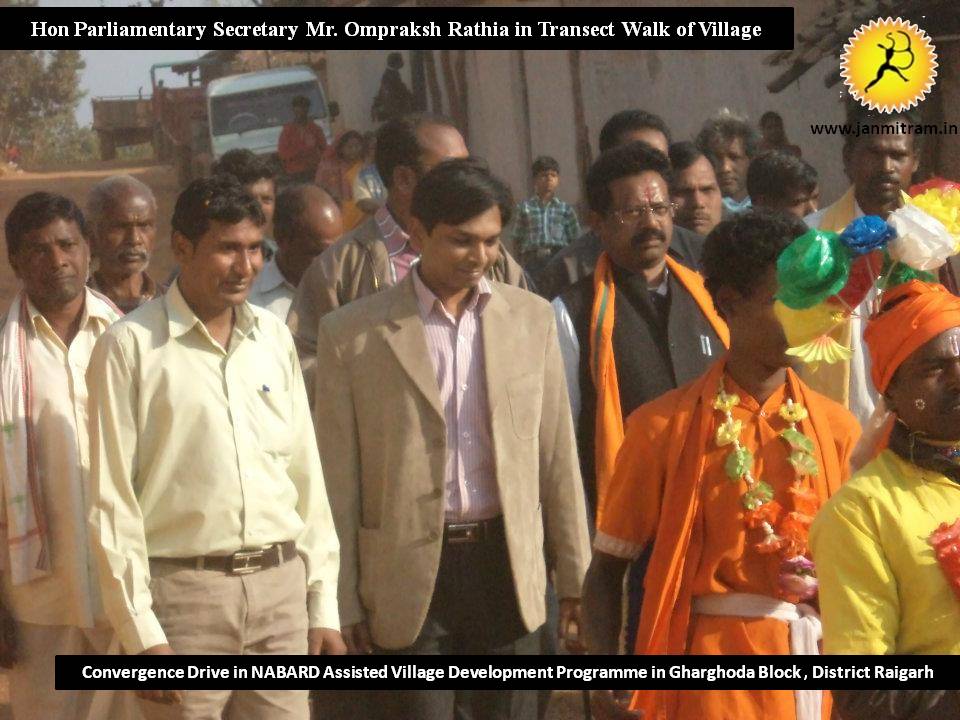
In this connection on 27th Dec,2011, A Farmers Meet was organized. Objective of programme was to galvanized development activities and peoples associations. Hon Parliamentary Secretary to CG Govt. and local MLA Mr. Ompraksh Rathia attended the programme. 


He declared sanctioning of many infrastructural and livelihood development schemes in project villages form his MLA-LAD fund and other govt. schemes. Some Promment Works Are High School Building at VDP Village Bastipali – 10 Lakhs, Pulia At Danginara Village – 10 Lakhs, Pulia At mithilapur ( Dangninara ) – 6 Lakhs, PDS Shops in Baronakunda And Tenda Village – 6 Lkahs, Boundary Wall of Anganwadis at Tenda and Baronakunda- 4 Lakhs

 
Above said Works come into-fore during PRA done by orgnisation at starting of VDP in these villages. Distribution of Seedkits, Vermicompost kits and other farm implements from Agriculture and horticulture departments. These were distributed agriculture inputs to 150 farmers. The programme was attended by over 800 People from SHGs, Farmers, youth, PRIs from Nearby Panchyats and Block, all enthusiastic with galvanizing development activities in the area. 

Further, Our team is Striving hard to Improve food production in the area through intensification of rice, increase in net cropped area in selected villages.  

---------------------------------------------------------------------------------------------------------
Contributed By Ashwini Chouhan, Programme officer -JanMitram +91-98265-82806